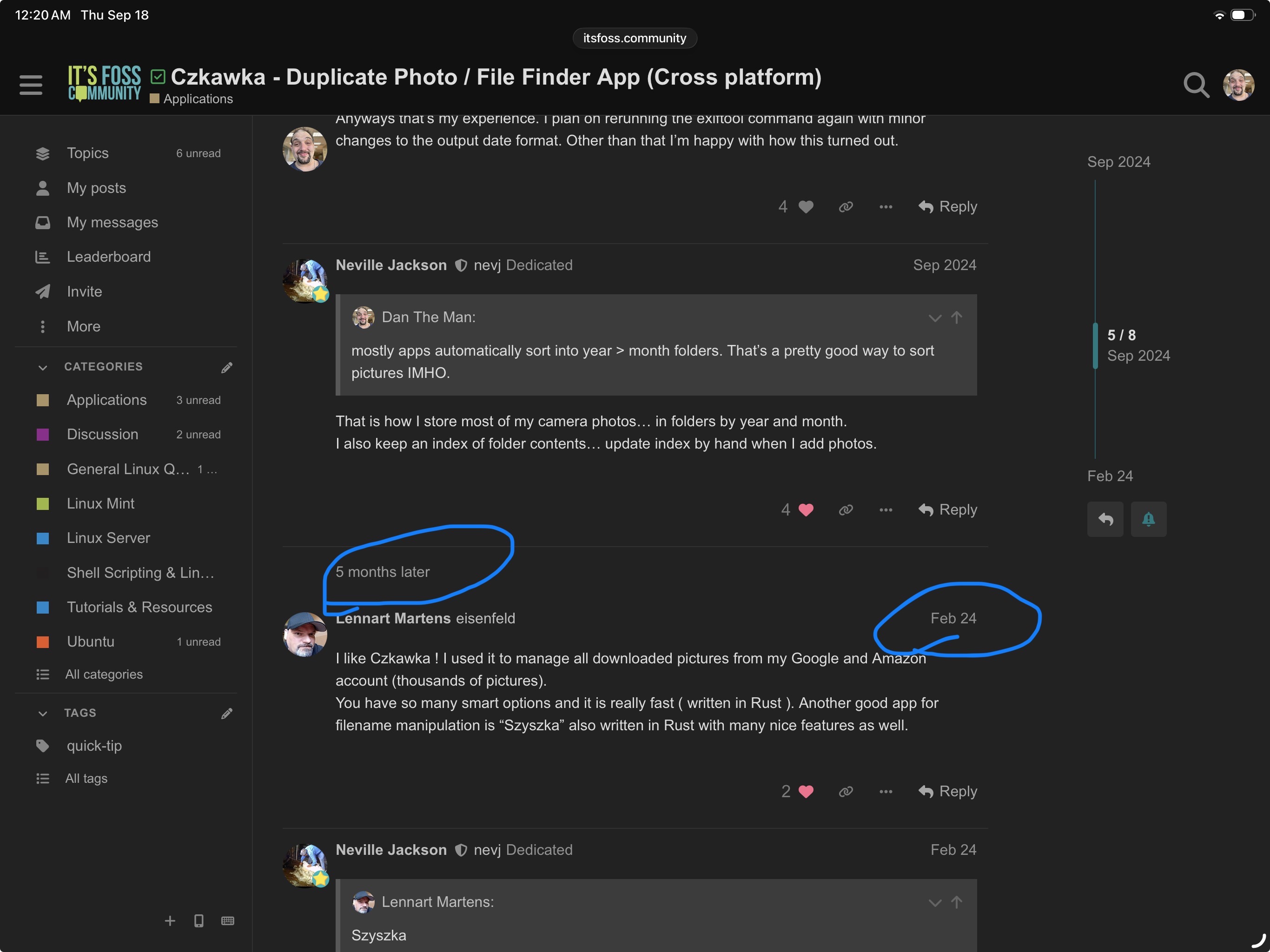
Hey guys, something I just noticed in my Cxkawka thread. I originally posted it in Sept 2024. A reply sometime later says 5 months later…and it’s listed as Feb 2024. It should be Feb 2025. I attached a screenshot, It’s not a big deal — just something I noticed. 
Thanks @DanTheManDRH
That ‘Feb 24’ also confuses me. Feb 24 here means 24th Feb of the current year. However, since many of us are habitual of DD-MON-YY styled dates, Feb 24 is often registered to the mind as Feb of 2024.
This is a Discourse feature and I’ll see if it can be changed.
You’re right. My mistake. I hadn’t even considered that it was DD not the YY. D’oh!

I mean… in fairness, there is a “September 2024” right above it, which should be an indication that it doesn’t use 2-digit years and would be unlikely to randomly switch into them. 
But that’s just me being unnecessarily generous to Discourse, I can certainly see how it could be easily misinterpreted. Especially in these times of abbreviated, unclear dates all over the place.
(I swear I’m emigrating to whatever country is first to pass a law establishing ISO-8601 YYYY-MM-DD as the only legal date format. With relative dates like “3 months ago” punishable by a jail term that lasts until at least 2050-01-01!)
Think you missed the boat on that, if it was going to happen it needed to be done for Y2K …. Remember that and all the issues of the world ending, no planes could flight or land.
Not old enough it was 2000 when all the older systems written with just 2 numbers for year would mean everything stopped. Big fuss about almost nothing. I worked in the IT department of a main hospital and the panic for the 3 years before. Plus being on call that night….
But we could also ask Microsoft and apple in excel why 1900 and 1904 leap year confused.
So good luck with your emigration
The date on your reply is a problem… Sep 25 can mean 25092025 or 092025
It they reversed it, 25 Sep, it would be unambiguous
Honestly, it’s criminal that Y2K is remembered as such a non-event by the public at large, when really it was a triumph of the entire IT industry working our collective asses off for months and months preemptively migrating services, replacing outdated equipment, and writing new code so that, when 1999-12-31 turned into 2000-01-01, exactly nothing of consequence happened.
It WOULD’VE been exactly the kind of global disaster described in the worst-case scenarios, if everyone hadn’t been motivated by those doom-and-gloom predictions to make sure they didn’t come true. The irony is, we succeeded so completely that most people came away with the (extremely incorrect) impression that it was all just exaggeration and fear-mongering.
The closest I ever came to seeing a Y2K bug - was some “bespoke” (i.e. crappy - nearly ALL
“bespoke” software is crappy and bugridden IMHO, especially if done with “rapid application development” methodology and shonky “Visual” tools from Microsoft) software assumed there was no 29/02/2000, and 28/02/2000 rolled over to 01/03/2000…
Yeah - the first year of a century is not a leap year - you got that right Mr Bespoke.
UNLESS its the first year of a millennia!
For our hospital it was not computer related but spécialiste equipment such as scanners, xray, image machinerie that were going to be the issue. Some drip pumps still have not been fixed but for them its no big deal as they are reset each time. The interface between a image and the related transfer software was also around dates where. American vs uk machines had the dates the wrong way round compounded by 2 or 4 years date format
The most commonly-encountered one “in the wild”, in the wake of Y2K, was actually so trivial it was funny. (We could all laugh, specifically becasue it was the only Y2K bug of note that statistically-significant numbers of people ever saw.)
Apparently due to the way common date-formatting functions were implemented in Perl at the time, it was fairly common to end up with a 2-digit year value a year value expressed in terms of “years since 1900” when constructing a date. You were supposed to add that value to 1900 to get the actual date, but lots of coders treated it as a 2-digit year instead, and just put “19” in front of it. So, lots and lots of Perl-driven web templates rang in the millennium1 by advancing the year from 1999 to 19100. 
Notes
- Pedantry about exactly which year a given millennium starts from is acknowledged but ignored.