Do computers need to be 'managed'

I use AI for finding out what an error message means. I mainly use google or duck search summaries, but if it is complicated I use ChatGPT. It is really helpful for debugging.

I find that when getting AI to interpret error messages I have to be very specific. It will alter its redponse if I give more detail such as which distro and versions of software. Sometimes it will alter its response if I reorder the words in my question. That means it has trouble extracting meaning from a sentence . I works best with a string of keywords and no linking phrases … ie bad english but concise list of words.

1 Like

Have you ever used AI to solve a non-PC problem?

Yeah. It is hopeless at higher maths, but it knows how to fix tractors and it taught me how to tune my tv antenna.
I think google scholar is a better source for scientific questions..
I think Wikipedia is a better source for general understanding .
Have not tried it for coding or translation.
Its real winner for me is interpreting messy error messages.
A satisfactory reply has to include explanations as well as instructions… if it can explain something I feel confident that it has the correct approach.

1 Like

I come from a completely different background to you. In my experience with scientific computing, the most stultifying computing setups were those that were ‘managed’ by someone other than the scientists/users.
I always encouraged staff to choose and maintain their own desktops and to participate in what was setup on servers. People felt enfranchised by this approach. They always managed their own laboratory equipment and my approach said that computers were just part of the laboratory.

I had several battles with centralists and with career managers who wanted to control something they knew nothing about. I did not always win, but I had some notable victories. The Free Software Movement helped me immensely.

Scientific computing is not a defined environment. Needs are always changing. It needs to be very adaptive. It cant wait for ‘management’ to catch up.

1 Like

That is where business computing is totally different. I managed a team of technicians in a hospital where we had to look down systems for patient records, data access, but give the ability to any truste memeber of staff to access a terminal and get the correct pâtes to servers.

So for example nurses station data entry clerk could book patients into the hospital, surgeon came needed access to xrays before intervention, pharmacy tech needed drug records, bed manager needed access to free beds…complex reboot log in systems. Bit by bit we moved things onto the intranet (internal internet servers without external access) to make it easily for access.

Only problem so many users so many pâtes so many possibilités and staff changes… they used to write passwords on a white board behind nurses station. We stopped that so they had a list taper under the keyboard.

1 Like

Yes, business computers have a defined purpose … and it changes only occasionally.
I lived in a world where computers were a general purpose tool … to be adapted to the job at hand each day. The only person who could do the adapting was the person who understood the the required task.
Whenever they made the mistake of employing someone who was not computer literate, it led to machinations because noone wanted to go and do someone else’s work.

1 Like

I prefer Lumo. It’s compatible with my Proton programs and shares the same privacy standards. And it seems as smart as any of the rest of them.

2 Likes

I was relatively lucky in that regard… the Manager that “owned” the clusters gave me a free hand and I worked with the users daily. Most of the software was very specialized, expensive and licensed by the seat. Installation of the software packages could take hours and a lot of it needed to be complied from source code. Once installed I had a few users that had the time to thoroughly test everything before full release to the rest of the users. All my users had extensive requirements and little to no time to spend on multiple cluster management, too.

Almost all sat on MS desktops and accessed the clusters through ssh and knew little about Linux other than the commands required to load, maintain, and run their data. I had lots of “teachable” moments and was happy to help them out. They could manage their own desktops with few issues other than security requirements and other administration requirements in a top secret environment.

Again, lucky for me, my only responsibility was to ensure their systems were properly setup to access and use my clusters as well as offsite clusters at places like Lawrence Livermore, etc. The day-to-day MS desktop system requirements were handled by a fully qualified MS Admin.

I understand your comments on management. I essentially had two different management groups that I had to satisfy, the “owner” and users of the clusters, all happy to hand over that responsibility to me, and then the separate upper level management that had no clue about computer administration or Linux. Their requirements could be onerous at times due to their ignorance of systems management which in general was minuscule. So I was able to work that to my and my users advantage. And, thanks to the owner of the clusters, I, and my users, won far more battles than we lost.

Every location is different and often has specialized requirements that are unique to the job. And that’s why I feel that AI is very limited in systems management capability, the subject of this thread.

Generic AI stuff is fine if the administrator has no other tools such as splunk, nagios, Grafana/Prometheus, cockpit, and general command line tools (btop, netcat, etc) that can give far more detailed troubleshooting and adminitrative real-time info than generalized AI agents.

Particularly in assisting both hardware and software root cause analysis when trouble happens, and it often does. Good systems administrators with skills in hardware and network setup and maintenance, programming and compilation skills, and OS management will always be needed for large installations.
2 Likes

AI does seem to “know everything”. … but it can only handle events it knows about. New problems will be outside its reach.
So yes, sites with unique requirements will not be servicable by AI alone.

I see it more as AI helping with drudgery. For example who , in Debian , sits down and tests that versions of each of the 50000 plus packages are compatable with all packages and the kernel.?
I think AI could help with something like that.

2 Likes

29 posts were split to a new topic: Who uses AI and what do you understand about how it works

Dear friends,
I apologize if I’m repeating my answer, but the thread is very long, and I had this post in my email to reply to.


Howard,
When you start a chat on ChatGPT, you can and should set the rules for how you want ChatGPT to behave. For example:
Rules:

  • Always provide concise answers, and, if necessary in exceptional cases, more complex answers

You can write rules as needed and copy and paste them whenever you open a chat, or you have a better option:
Create a chat dedicated solely to rules.
To start, you can have one rule, and then tell it to “save this rule as the rule baseline.”

When you add another rule later on, say, “Add this new rule to the rule baseline and update the baseline.”

Since ChatGPT tends to “forget,” to “remind” it, whenever you start a new chat, say, “For this chat’s rules, use the rule baseline,” and you’ll start having “conversations” tailored to your way of working.

Jorge

2 Likes

Hi ihasama,
Sorry for asking, but you mentioned a topic I’m really into.
Do you have any DIY audio projects on a public page?

Thanks

Jorge

1 Like

Hi Jorge,

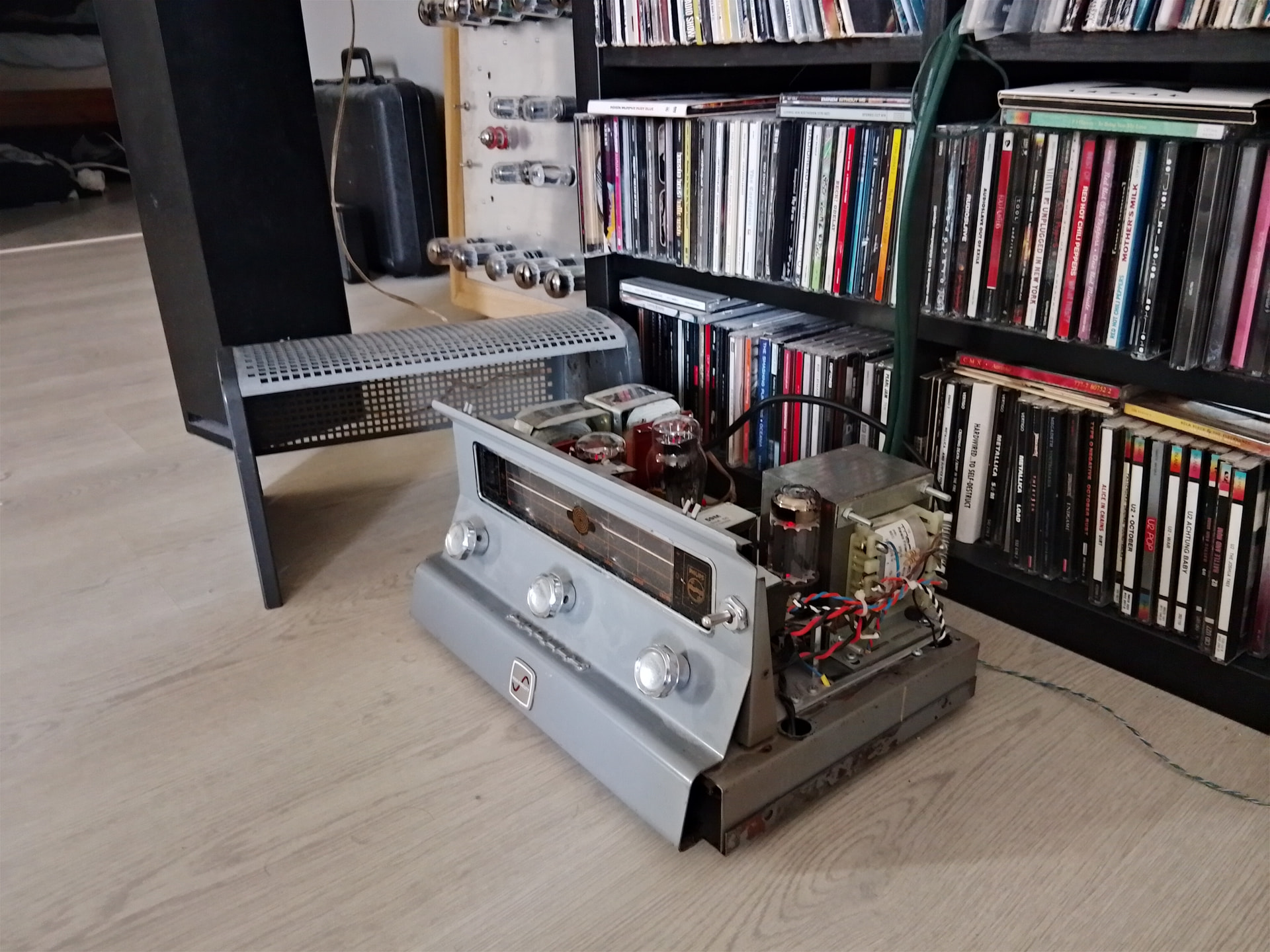
I don’t have anything on a website but here’s my latest amp. It’s a 45 SE amp, appr. 0.75W. All my stuff except CD player are DIY: speakers, turntable, RIAA, preamp and three different power amps, all use tubes.

2 Likes

Not seen a valve amp for a very long time. I started as a DJ at 18 to gain some money and my first amp was valves. But it got far too hot and changing valves was risky so moved on to solid state very quickly.

2 Likes

I’ve done few amp heads for guitar players and the most important thing is to hide all parts inside an enclosure and keep the tubes also behind some mesh so no one can swap tubes without powering off the amp. They get hot!

2 Likes

From part of me trying to understand AI better.

2 Likes

Hi ihasama,
Thank you so much for sharing the photo and congrats on your audio work! :clap:

In your last post, you brought up another important topic: guitar amp heads.
I’d like to build a simple one to use at home, with a maximum of 1–2W. Do you have any recommendations?

Sorry for going off-topic.

Jorge

1 Like

It’s quite common here but let’s not go too much into tube amps here :grin:

Easiest and cheapest option would be buying an old tube radio and adding an input jack to it.

The one tube solution would be ECL82 (or PCL82) tube SE: ECL82 SE1

You can leave the rectifier tube off and use diode bridge there. Cheap output transformer is fine with this amp

1 Like

Is there a real difference in sound quality making them better than solid state practice amps which are really cheap to buy. Especially as you are talking low watt output.

1 Like

My understanding is that a token is a phrase … a string of X words. Right?

So if you string words together in the right order it looks like understanding ??

That math says … choose the token of largest probability conditional on all(?) previous tokens.
So it is conditional probability.
That is how it constructs a sentence.

I wonder how it interprets a sentence … ie how it deconstructs your sentence. It might just break the question up into tokens, then make them the start of the list of things it is conditional on?

The sequence of tokens is important. The tokens are ordered in a sentence. I wonder how it can be conditional on an ordered sequence of tokens.? I think there is maths that can do that … a hidden Markov model maybe. ?

I need to read more.
I need a review paper on the maths behind AI

1 Like