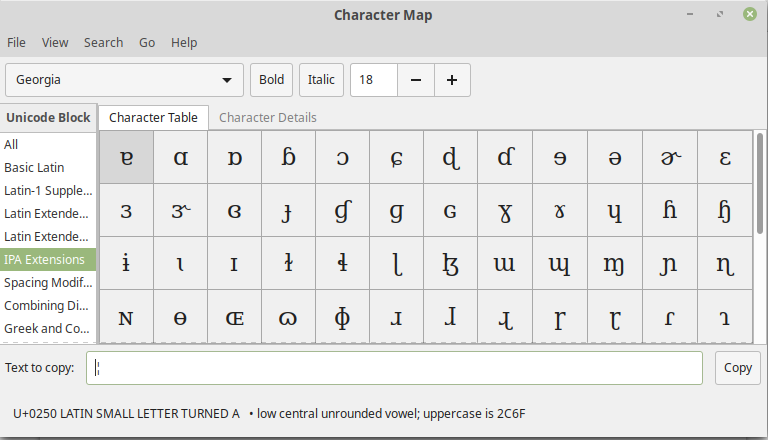
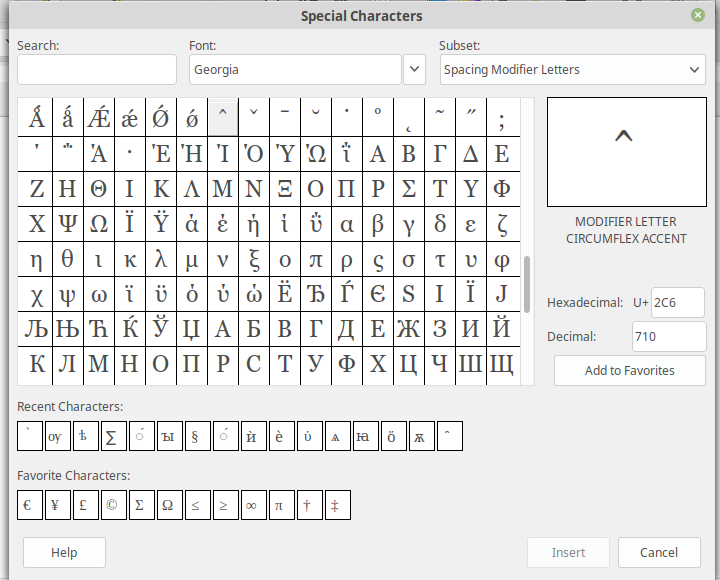
Why doesn’t LibreOffice’s Insert Special Character option show all characters [[in the fonts housed in /usr/share/fonts/truetype/msttcorefonts/]]? Character Map (under Accessories) reports that Georgia, for example, has a Latin-1 Supplement block, a Latin Extended-B block that goes all the way to U+024F (ɏ) and an IPA Extensions block.
I can copy and paste any character from there into any LibreOffice application. But if I open Insert Special Character (in Writer or Calc) and choose Georgia, Latin-1 Supplement and IPA Extensions are missing altogether, and Latin Extended-B ends at U+01FF (ǿ).
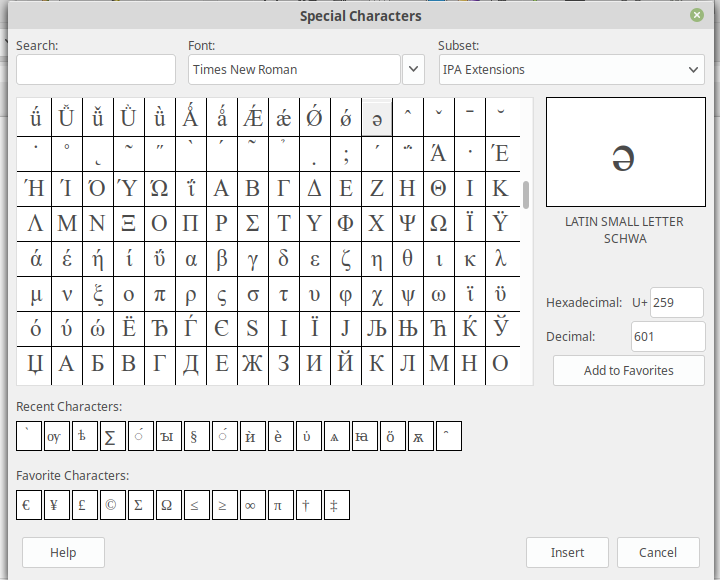
Similar things happen with Times New Roman, Courier New and the rest, though not to the same extent: for example, some have one IPA character, namely U+0259 (ə), but again Character Map attests that there are many more.
I’m getting this with LibreOffice 6.1.5.2 under Linux Mint 19.1, but my older computer, with LibreOffice 6.1.4.2 under Ubuntu 16.04, suffers from a softer version of this thing also (Times New Roman is all right, but Georgia misbehaves in the same way).
Update. I was wrong about only the fonts in msttcorefonts being affected; in DejaVu Serif the Insert Special Character dialogue displays the entire IPA Extensions block (U+0250 to U+02AF), but the Cyrillic block goes from U+0400 to U+04F9 rather than U+04FF; and in Ubuntu (the font, not the Linux distribution) the IPA Extensions block is limited to one character, U+0292 (ʒ).
Hi
I have just checked this with version 6.2.0.3 which is available in flat packs via software manager in Mint 19.1 and was able to do all of them by using insert. I did a few to check. So I think that if you do the upgrade that might answer your question. Just one thing, uninstall the version you have now or you will have to copies of Libre Office, but with different version numbers.
Tried 6.2.0.3, tried 6.2.1.2 (removing and purging the old version every time before installing the new one), all with the same results. Evidently the version doesn’t make a difference.
Sorry then I can’t help any further, because when I pressed insert and then went to special character it worked every time without fail no matter where it was in the document or if I was in bold or not. Oh I have found that there are two symbols that are for putting special characters. Sorry I don’t know the name of them, but they look like horse shoes and if you enable both of them, you extra characters to insert.
A major obstacle to people who want to move from Win or Mac to Linux is that LO does not have an easy way to create shortcuts to insert some symbols or special characters. For example, I need those and have to pay Textmaker (from a German company who indeed did a good job over the years to create a word processor that could convert MS word files better than LO or OO did):
ĀāĒēǦǧĠġĪīŌōŪūḌḍḎḏḤḥḲḳṢṣṬṭṮṯẒẓ
Other solutions exist such as auto hotkeys but I am told that if I use only ALT + the letter I need to modify I will encounter lots of troubles with some other programs. Anyone could create an extension for LO?
Accented character always cause a problem in all languages and with most systems, only real answer it to stop using them. ……. But takes a brave government to try that, it was suggested here in france a few years back but got no further.
In principal when you install linux it asks your country (or works it out from the internet) and asks for your keyboard layout. Then the keyboard does the rest for accents.
I was setting one up for a client a few weeks back, chose a french keyboard as it was azer against quert but then réalisés there was a key not correct as it was a swiss keyboard, so similar except for 2 letters. Same with accents. Try mapping a mac french keyboard to linux and that thinks its totally wrong struggled with @ and “ keys.
Hi Paul,
What you mention, AZERTY or QUERTY keyboards, is a different matter, because they are physically different I understand that, and that’s why I asked, because I could have misinterpreted it.
If I have a keyboard with a PT layout, I can type with accents in both Windows and Linux. However, because I’m “crazy”, I work with a keyboard with a US layout and, obviously, it doesn’t have characters with accents, and I have to use the “English (Intl. with AltGr dead keys)” layout during installation, but it has all the characters (with key combinations, of course) except for the character “çÇ” (I think that’s the only one).
When I finish installing the distro, I install the EurKEY layout so I can use my US keyboard with all the PT characters. It’s still with key combinations, but it’s very easy to use (in my opinion).
@Jorge, thanks for your answer; i didnt know EurKEY. But even so, i don’t see there the signs I need. I found out that I can add some of the characters I insert most commonly in a list of “favorites” that come under the LO “insert character” table.
Wow never seen that before, that could be the answer to so many questions on layout. Normally I just bring up the on screen keyboard to find a special character. Thanks jorge
One of the things I like most about Linux is the Compose character — the fact that one can input a large variety of characters regardless of the program, meaning that no special shortcuts for LibreOffice are needed. So as soon as I have installed Linux on a computer, I know that at any time I can input, into the terminal or any program, ‹ā› by ‹Compose a -› or ‹ġ› by ‹Compose g .›. Or ‹ǧ› by ‹Compose c g›, ‹ẓ› by ‹Compose ! z›.
And this behaviour can be modified, so if one also needs an easy way to type ‹Ḏ ḏ Ṯ ṯ›, which do not seem to have been pre-programmed, one can add them. Likewise ‹Ā› and ‹Ō›, which should be obtainable by Compose, the letter and either a hyphen or an underscore, but are broken.
But in general the alt gr Key which is on the right side of the space bar.
On most french keyboard to get things like accents or even the @ symbol thats what you use. Our keyboard show the accepted letter and again alt gr to obtain it.
I have a US international keyboard, configured with compose key on r-alt and dead keys configured for Linux. This means I can use the following literally everywhere in Linux, including in LO.
This results in me being able to press " (the dead key) and “a” to generate ä, or ’ and “o” to generate ó. There’s a lot more dead key combos like that I have access to. It takes getting used to, but once you’re used to it, it’s second nature. When I want the character provided by a dead key on its own, I just press space after pressing the dead key.
R-alt + shift + “;” gets me the degree symbol “°”, but there are others such as € (R-alt 5) and ß (R-alt s). Actually, almost my entire keyboard provides nice key combos with R-alt or R-alt-shift. Why they put “±” on R-alt-shift-m, I don’t know.
Yes. It’s easy too to find names of special characters. Problem is: it’s not particularly helpful when reading back what you wrote before you compile; the way of typing these symbols out is not particularly helpful when editing for reading them back.
Many thanks for the answer(s). I did not have the time to get back to this and for now I just stick to TextMaker NX and the shortcuts I created there but which indeed function only there. I must indeed learn the Compose Key way… asap.