Tool as GUI to see and navigate through a .tar.gz file but without unpack?

Hello Friends

If you have a big .tar.gz file (and even with a long directory structure) and you want only see the content (and even be able to navigate through the directories) but without unpack it.

All this through a GUI. What tool do you suggest?

Something like https://www.7-zip.org/ (even Winrar) for Windows

Thanks for your understanding

Hi @Manuel_Jordan , :waving_hand:

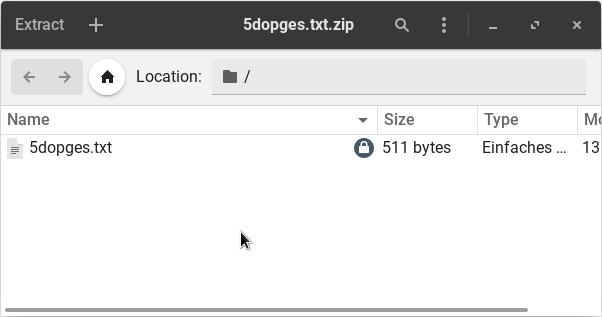
my system Linux Lite came with file-roller preinstalled.

Right-click on the respective file, select file-roller (“mit Archive-Manager öffnen”, in my case) and you see the contents before unpacking.

Cheers frorm Rosika :slightly_smiling_face:

I backup my /home folder into a tar file. All I do is double click on the tar file and I can see the contents and browse thru it. No utility needed. I use Mint and Nemo file manager.

Hello @Rosika

Thanks for the quick reply and suggested tool.
Just being curious in what OS you are working? (it because you have the tool already installed)

A warm hug from here :people_hugging:

Manuel

Hello Howard

Thanks for the reply

I backup my /home folder into a tar file. All I do is double click on the tar file and I can see the contents and browse thru it. No utility needed. I use Mint and Nemo file manager.

In my case If I do double click the “.tar.gz” is completely unpack it. I am working in Ubuntu and it uses GNome (I think Nemo is used too)

Hi @Manuel_Jordan, :waving_hand:

I dual boot Linux Lite 6.2 and MX Linux 25.1.

file-roller came with Linux Lite.

For distros with apt package management you can post-install it with:
sudo apt-get install file-roller

In MX xarchiver is installed. It works pretty much the same way.

Many greetings from Rosika :slightly_smiling_face:

P.S.:

If you are interested, here´s a comprehensive article about archive managers:

The site is in German though. But you can read it in English via e.g. firefox´s built-in translator.

Thanks for the reply Rosika

Interesting, you have 2 tools according the distro

  • Linux Lite → file-roller
  • MX Linux → xarchiver

For distros with apt package management you can post-install it with:
sudo apt-get install file-roller

Thanks for that

P.S.:
If you are interested, here´s a comprehensive article about archive managers:

Thanks for the link and suggestion about the language

Take care Rosika

I just use “t” (instead of x) to type the contents of a tar file - can use less / more if I want to see a longer list…

In fact - I almost ALWAYS run “tar tvf tarfile.tgz” even when I’m going to untar the file - to make sure it doesn’t have stuff like “/” which will untar to root…

tar tvf BigTarFile.tar.gz |less

Hello Dan

I use the command approach too, but some times when I am really very tired due the job I need the GUI to have a “better perspective”

Interesting the .tgz file extension. I thought it was a typo of .tar.gz

either / or…

Both are good… “tgz” was more comonly used in MS-DOS with the old 8.3 naming standard… (i.e. 8 chars, a dot, then 3 chars)…

As you’re probably aware UNIX / Linux was never as strict about filename extensions - man was MacOS (System 6, 7 etc) fussy about files! Not just the extension - they had attributes about what type of file they were… I remember I once had a floppy disk with Targa *.tga files on it - Mac System 7 would see the floppy, and the files, but REFUSE to open them in e.g. Photoshop…

I mean you could call your tar file anything, and it wouldn’t matter and tar would still be able to read it…

╭─x@titanii /tmp  
╰─➤  tar czvpf sometarfile.file.file.txt qipc_sharedmemory_SayonaraMemoryhomex0240207001a637e9998c1cb4a954109ada26d9f3 qipc_systemsem_SayonaraMemoryhomex0240207001a637e9998c1cb4a954109ada26d9f3 qtsingleapp-XPPenT-6c81-lockfile
╭─x@titanii /tmp  
╰─➤  tar tvf  sometarfile.file.file.txt                                                                                                130 ↵
-rw-r----- x/x               0 2026-05-07 12:02 qipc_sharedmemory_SayonaraMemoryhomex0240207001a637e9998c1cb4a954109ada26d9f3
-rw-r----- x/x               0 2026-05-07 12:02 qipc_systemsem_SayonaraMemoryhomex0240207001a637e9998c1cb4a954109ada26d9f3
-rw-rw-r-- x/x               0 2026-05-06 18:29 qtsingleapp-XPPenT-6c81-lockfile

I like that. Unix got it right.
Android is a a pain in that respect. … if a file has a strange extension or no extension, you cant view it.

This is why I like epub file format - it’s just a zip file with HTML content… I can unzip it with unzip…

I bet you cant unzip it in Android if you change the extension.

probably no different in iOS either…

I don’t usually try and do “file things” on Android anyway… very occasionally in TermUX with TermUX files… But I don’t usually try messing with stuff outside of TermUX’s own folder tree…

And I use ResilioSync to sync stuff to (and from) my phone…

e.g.
Music files from PC (Linux) → Android
Photos from Android → PC (Linux)

And that prompt that nags you “what app do you want to use?” to open whatever it is - and I never know whether to tap “Always” or “Just Once” so - I usually tap “Just Once” because I don’t want to have to delve in the settings menu to change it again…

I think maybe I ought to do that.
sftp from termux is fiddly.

When I was stuck on Android 10 on my Galaxy S9+ - ResilioSync wasn’t reliable enough to trust…

I used adb-sync - which was kinda like rsync but did adb stuff over USB connection between PC and phone - it was CLI only - but it was easily scriptable…

But I replaced the S9+ with an S23 Ultra in July last year and ResilioSync worked flawlessly - mostly - proviso - either an android, or app update broke it for a few months - i.e. the app had to be continually restarted to keep syncing - but a subsequent update fixed it - I don’t know if it was an Android or app update that “unbroke” it - but it seems so flaky when updates happen - I REFUSE to update my Samsung Android 16 further…

My problem is I dont do it often enough and i have to relearn how every time I need a file transfer.