FuriLabs has manufactured custom mobile hardware to run their mobile Debian distribution called FuriOS. The hardware, enabled by hybris, creates a functional Linux computer in mobile form factor. Their goal, as I understand it, was first to create a usable Linux mobile phone, and in this I say, they have succeeded in spades.
I have long been interested in the evolution of mobile technology and its liberating potential. Admittedly, it took me awhile to also become aware of the invasive potential of mobile technology, which has only grown as a concern. By the time I figured some of this out my work-life dependency was well entrenched and so was my personal everyday carry. Like many others I use my tech to read books, to keep up on the news, to buy and sell, to share life’s moments and to have a mobile office. Turning that all back now is not practical so one must figure out how to slow or stop the invasive snooping through our devices.
I worked my way through the de-Googled Android variants (which I still like but are not really full computing devices) but the dream was in having my Linux PC in my pocket. I have used Ubuntu Touch and Sailfish which seemed at the time to be the two most advanced Linux mobile options. UT has a nice UI, but lacks the app ecosystem for my needs. I do like the SFOS UI, it reminds me a bit of BB10, but I find their path to be Euro-centric rather than global. In an attempt to expand this I connected with a gentleman who had built Sailfish ports on Motorola previously and asked if he would port SFOS to the Motorola G7 Power. He eventually agreed and so I sent him a newer G7 Power to port on. My only claim to fame is that I provided him the hardware, he did all the heavy lifting with the assistance of the incredible SFOS porting community. You can find his port on talk dot maemo dot org.
Somewhere in the middle of 2024 I found Furilabs who had manufactured their own mobile hardware called the FLX1 on which they run their custom mobile-centric distribution of Debian called FuriOS (read furious). While still relying on hybris they have access to the hardware at a level that allows them to make it all work together rather seamlessly. It does not feel like a port in progress, all the typical hardware works with some expanded bits still in progress (like dual sim) but nothing impeding phone functionality.
I can hear the purists grinding their teeth about not having mainline Linux on non-hybris hardware, to which I would respectfully reply won’t be a usable thing in the near future and should not interrupt the joy of having a Linux computer on mobile today. Embrace where we are, perhaps tomorrow will be different, be part of the solution where ever you can.
I followed Furilabs progress through their Telegram channel ( Telegram: View @furilabs_chat ) until December of 2024 when I finally bought the FLX1, a rugged phone with a removable battery almost identical in form factor the Gigaset GX6 but one that always reminded me of a rugged version of the 1Plus 7T. I am not a flagship phone kind of guy, I prefer a big battery, a good camera, ample storage, and reasonable mid-range hardware. The FLX1 has all this in spades with a 5000mah battery, a vibrant screen and custom camera software developed by Furilabs that took good pictures right out of the box.
FuriOS itself is built on Debian with a custom Waydroid fork they call Andromeda and Phosh as the desktop environment. Android apps show on the home screen like Linux apps and are therefore accessed like any other app. This reminded me of how SFOS looked with AppSupport, even if the integration was different. It turned out that I could install and use my required Android work apps with Andromeda and then shut that all off at the end of the workday, keeping work and home separate; it was a nice dividing line for me. It has taken time and experimentation to find the daily use Linux apps I like on FuriOS, and indeed this is limited compared to available desktop options, but that was a part of the fun of the Linux mobile adventure. Exploration and discovery. What I’m finding now is that I’m using the mobile apps on my desktop.
In the early days of 2025 FuriOS was not very smooth and I found myself rebooting the phone a lot. So not yet time to move my mobile eggs into this basket, but the promise of a Linux computer in my pocket was looking quite real. I didn’t buy the FLX1 to immediately switch from Android anyway, I bought it because I could see the promise of what FuriLabs was building, and I could hear the passion in their communications with their Telegram community of their vision. The goal was to have first and foremost a fully functional daily driving Linux phone that did all the basic phone stuff: calls, sms, mms, email. After that was achieved other enhancements would come. And they have.
I am amazed at the amount of active development that I have witnessed in a single year which included monthly OS updates until recently. The development team has been very interactive with hardware owners in the Telegram community, they even added in a mobile band that I needed in my part of the world. Over the course of 2025 FuriOS became more stable and more usable which included longer battery life and an effective OOM killer. I found myself using it for a few weeks at a time, cycling it with my LineageOS phone for daily use, all the while finding new software for my daily use.
On the modem side, it operates in 4G LTE with 5G being worked on but not reliable on all carriers; some of that seems like a carrier issue not a hardware issue. If I had one hardware thing I’d like to see improved it would be more reliable GPS access, but this was the same under SFOS, so likely something that will mature with Linux over time. Not complaining, just mentioning. Perhaps I should learn to program and be part of the solution.
On the UI functionality side I wish there was better access to Gnome extensions or desktop widgets in Phosh. Under Android I use these to keep myself on track with my calendar and other notifications, but this is still a work in progress under Phosh in FuriOS. I don’t mind Phosh, and one can also dual boot into Ubuntu Touch on the FLX if they prefer. @PIGGZ was working on an SFOS port for the FLX, wouldn’t that be interesting to see come to life. The developers seem pretty open to working with others, so perhaps there will be additional desktop environments available in the future on FLX hardware. I’m hoping for the Marathon developers to come by as I have a fondness for the BB10 look and gesture navigation.
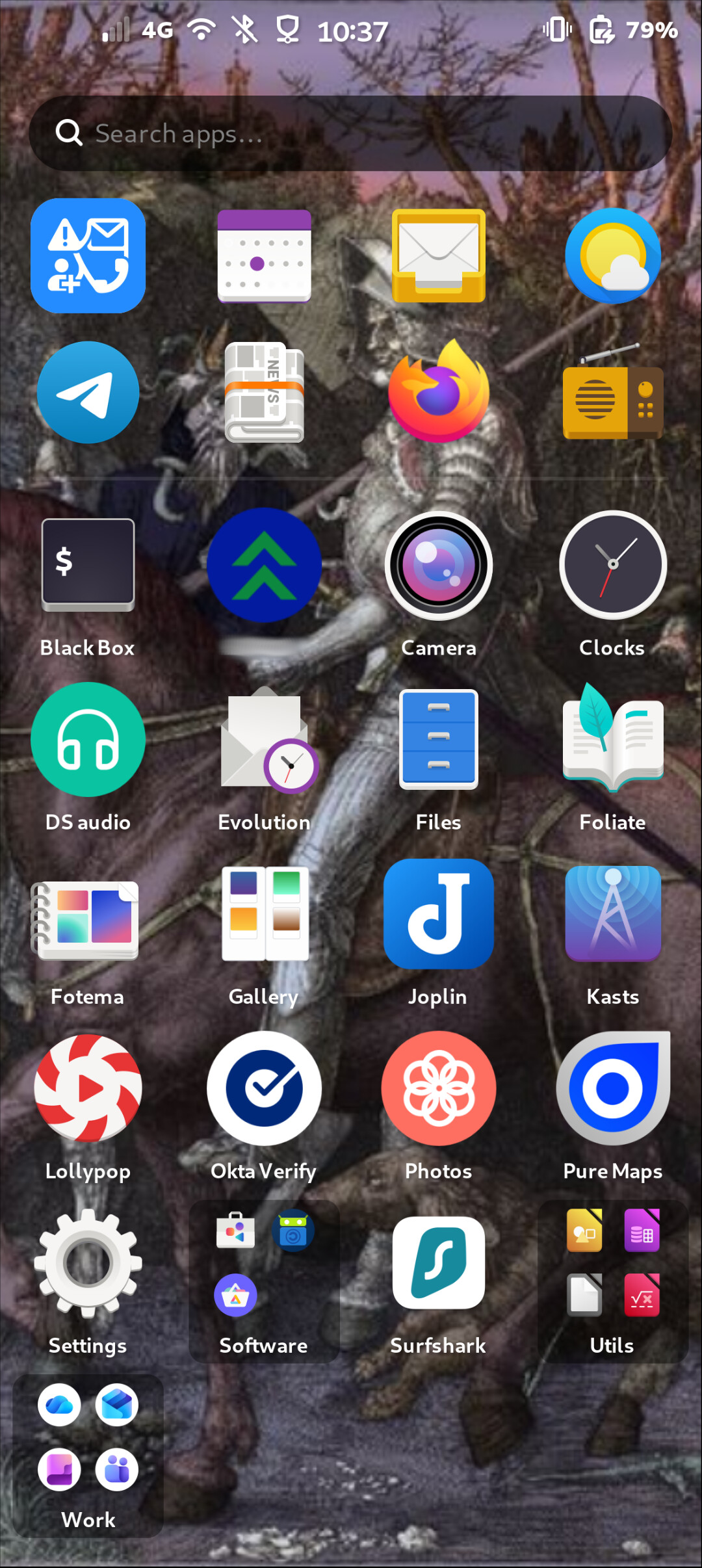
Daily Driving Now: Today my FLX1 is my daily driver. I have encrypted the device for greater access control and added in a VPN. Depending on use I can get two days of battery life in a smooth, dependable mobile phone experience. I interact with other mobile ecosystems without issue including MMS. This is a testament to the hard work poured into the product by FuriLabs developers. The device just works and works reliably.
New Hardware from FuriLabs: At the end of 2025 FuriLabs introduced the FLX1s, their new mobile hardware, which is a slimmer, sleeker, non-rugged device with hardware switches to shut off microphone, camera and modem/gps. The new hardware comes with 8GB RAM/128 GB storage, 5000mah battery and is a true world phone with the available bands. The FLX1 is no longer available for purchase being replaced by the FLX1s. Despite the FLX1 being yesterday’s model, FuriLabs motto is “Planned Permanence” and they actively develop for both hardware models on a roughly bi-monthly schedule. Every update brings some goodness, see the changelog here: https://furilabs.com/changelog/.
The Telegram community is growing with new device sales and includes folks who know much more than I do about Debian and programming. This has helped me learn how to better use the device and to find applications that are more feature rich. Although there is not application parity with Android, what is available is growing. Some of the community members are adding their own app projects to fill gaps for themselves, which is helping us all; because this is a real computer, some of them develop directly on the FLX. I try to do my part by being a tester where I can.
A Convergent Future: The promise of convergence, first hinted at by the original Ubuntu Touch, is now a reality at FuriLabs. This month they released their convergence hub hardware called the FLH1 which allows FLX owners to connect to a single monitor through custom software while enjoying access to several port options. While not fixing the lack of adaptive applications, it will allow for the full potential of Linux applications to be used in the hub setting on a full size monitor. The hub hardware I understand has the future capacity to handle 2x monitors, but this is not yet available. I have yet to purchase one, but will report back when I do. I am very much looking forward to testing this bad boy out as part of my mobile office.
Summary: In just over a year the FuriLabs team has taken their custom mobile phone hardware from the promise of Linux mobile to daily driving reality. A proper world phone, the UI is smooth and stable allowing almost anyone with basic Linux experience, and the willingness to work within present limitations of Linux mobile, the ability use it as intended – as a mobile phone. For those who still need access to Android apps, like myself, FuriOS has us covered. The FuriLabs family of mobile devices is ready to daily drive, now, right out of the box on a wide variety of global carriers. If you are looking for Linux on mobile it’s worth taking a look at.
